CCTV cameras have a history that goes back farther than most people think. Early systems were designed to let people watch events from a distance not for the kind of remote security monitoring that we use today.
If you are asking when CCTV cameras were invented the answer will change depending on what you mean by CCTV. An early mechanical system appeared in 1927 while the first well‑known electronic CCTV system was installed in 1942.
When Were CCTV Cameras Invented?

The history of CCTV does not start with one camera or one inventor. It was built through different inventions over time. One of the systems was a mechanical television surveillance setup created by Russian inventor Leon Theremin in 1927. This system used a scanning camera to send images to a receiver. It was used to watch people approaching the Kremlin.. This early version looked very different from today’s security cameras. The image quality was low. It needed someone to run it manually.
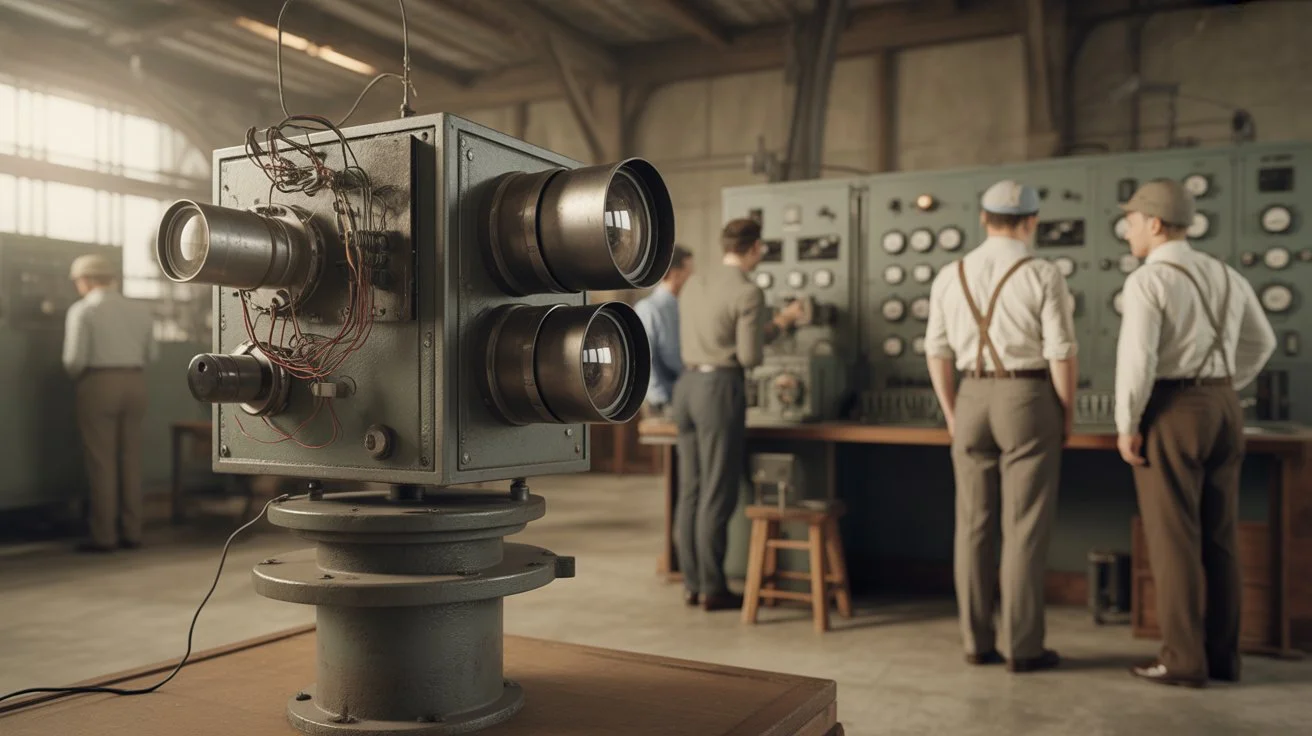
A big change came in 1942 when Siemens put up a CCTV system at Test Stand VII in Peenemünde, Germany. This system let engineers observe V-2 rocket launches from a distance. German engineer Walter Bruch is often linked to the design and installation of this system.
So when people ask when CCTV was invented two dates usually come up: 1927 for a mechanical surveillance system and 1942, for the first electronic CCTV system that became widely known.
Who Invented CCTV Cameras?
There was no one person who invented everything we now call CCTV. Leon Theremin made a mechanical television surveillance system in 1927. His work showed that a camera could capture a scene and send the image to another location. Walter Bruch later had a part in the development of an electronic CCTV system, at Peenemünde in 1942. The system was built to watch rocket launches without needing workers to stand to the launch area. This is why the question “Who invented CCTV?” needs some context.
The answer changes depending on whether you mean:
- An early mechanical television surveillance system
- The first electronic CCTV installation
- The first commercial CCTV product
- The first network-based security camera
Modern surveillance technology came from many steps rather than one invention.
When Was the First CCTV Camera Used?
The first major use of CCTV began in 1942 at the German rocket testing site in Peenemünde. The cameras were not put in place to prevent theft or protect a home. Their purpose was to let engineers watch rocket launches from a distance. The camera sent the image to monitors that were located away from the launch area. There was no internet, no smartphone app, no cloud storage and no remote access like we have today.
This early use also helps explain an idea in the history of CCTV. CCTV was first valuable because it allowed people to see an event without being near it. That basic idea is still at the heart of surveillance systems. Today a camera can let a property owner check a driveway from a phone. Back in 1942 the same idea helped engineers watch a rocket launch from a safer spot. The goal was the same: to see something without being, in harm’s way.
How Did the First CCTV System Work?
Early CCTV systems were basic when compared with todays equipment. A camera captured a picture. Sent the video signal through a closed connection, to a monitor. The signal did not go through a public television broadcast. That is where the term closed-circuit television comes from. The video stayed within a defined system than being sent to anyone with a television receiver.
An early setup generally needed:
- A camera to capture the scene
- Transmission equipment to carry the video signal
- A monitor to display the image
- Power and wiring to keep the system operating
I used the system to watch live feeds. I notice it is very different, from a CCTV installation that has cameras, an NVR or DVR storage drives, network connections, mobile access, motion alerts and analytics.
When Did CCTV Cameras Start Recording Video?
Early CCTV systems were mostly created for watching things as they happened. Saving video wasn’t something you could do by pressing a button and putting it on a hard drive. The tools to keep video recordings needed to get better before it was possible to record and store video. Magnetic video recording helped fix that problem. Video tape technology came along in the 1950s. The first machines that could record video on tape were very costly and big.
Later the technology got easier to work with especially when videocassette recorders appeared in the 1970s. This made it simpler to record, delete and use the video again. This was an improvement. A live camera could show what was happening at the moment. A recording system could keep a record of what happened. That difference made CCTV more helpful, for looking into security problems.
When Did CCTV Become Common for Security?
CCTV slowly started to move from uses into places that everyone could see. It began appearing in areas, businesses, places where people travel and other places where security was needed. London started using CCTV systems in the 1960s. By 1963 CCTV was already being used for watching traffic in Munich. These uses showed that cameras could be helpful in more than factories and military areas.
CCTV for businesses also started to appear in the United States. In 1949 a commercial system called Vericon came out in the U.S. It was linked to Remington Rand and CBS Laboratories.
Just because CCTV was available, for sale did not mean that every home or business started using it right away. The early equipment was very expensive storing the videos was hard and the systems needed machines. Over time better recording tools, cheaper equipment and better cameras made it easier. These changes slowly made CCTV more common.
When Was CCTV Introduced to the Commercial Market?
When was CCTV introduced? The answer depends on which market you’re talking about. The first electronic CCTV systems were already being used for special purposes, in the 1940s. In the United States commercial systems started appearing by 1949. However the technology took years to become something that could be used widely for security.
The main problems were cost the ability to record the quality of the cameras and how big the systems were. A business could not just buy a camera connect it to Wi-Fi and watch it from a phone. Early CCTV required equipment and lots of wiring. That is why the development of CCTV should be seen as a timeline of a single date when it was first introduced.
When Did Digital CCTV Cameras Become Popular?
Digital technology changed surveillance in a way during the 1990s. Before that most surveillance used analog CCTV systems. These systems usually sent video to a DVR or some kind of recording device.. With digital systems, storing, searching, copying and managing video became much easier.
Digital multiplexing made it possible to handle many camera feeds at once. Time-lapse recording and motion-based recording helped cut down on storage needs. That solved some of the issues that had limited older analog systems.
Take a business with cameras for example. In the past each camera might have had its separate recording process. That meant work and more storage. With systems the business could manage all recordings together. Everything was faster, cleaner and more organized.
Digital storage also made finding footage simpler. Of going through physical tapes operators could use software to search for recordings by date, time or other details. It was an improvement, in how people worked with surveillance footage.
When Did IP Security Cameras Become Popular?
The next big step came when security systems moved from analog CCTV to IP cameras. In 1996 Axis Communications released the centralized IP camera, the Axis NetEye 200. This camera could. Receive data over computer networks. It was very different from today’s cameras though. The NetEye 200 couldn’t deliver the real-time video that people expect now. Then network speeds and bandwidth were much slower which limited how well it worked.
Even with its limits the idea was a big deal. The camera didn’t need a cable link anymore. It could connect through a network. That change made remote viewing possible. It also made network video recorders, software for managing cameras and cloud-based surveillance systems a reality. As the 2000s and 2010s went on IP cameras became more common. That was thanks, to network setups, faster processors, more storage options and stronger internet connections. The technology kept growing. So did the use of IP cameras.
How CCTV Cameras Have Changed Over Time
The easiest way to understand when CCTV Cameras were invented is to look at the stages of development. CCTV Cameras have gone through key periods.
| Period | Major development |
| 1927 | Early mechanical television surveillance system |
| 1942 | Electronic CCTV used for rocket launch monitoring |
| 1949 | Commercial CCTV system available in the U.S. |
| 1950s | Videotape recording technology develops |
| 1960s | CCTV expands into public and traffic monitoring |
| 1970s | Videocassette recording makes surveillance recording easier |
| 1990s | Digital recording and multiplexing become important |
| 1996 | First centralized IP camera introduced |
| 2000s | Network cameras become more practical |
| 2010s | HD, mobile access, cloud systems, and smart cameras expand |
| 2020s | AI analytics, edge processing, smart detection, and advanced IP systems grow |
I think the important lesson is that CCTV did not suddenly become modern. Each stage solved a problem from the generation.
How Modern CCTV Cameras Are Different From Early Cameras
Modern cameras are smaller clearer, smarter and easier to manage. I think an early CCTV system was mainly designed to show an image on a nearby monitor.. I know that a modern CCTV system can do much more.
For example, today’s security cameras may offer:
- High-definition and megapixel video
- Infrared night vision
- Motion detection
- Person and vehicle detection
- Remote smartphone viewing
- Local or cloud recording
- Network connectivity
- Two-way audio
- Digital zoom
- Wide-angle coverage
- AI-based video analysis
Modern systems can also link cameras to one NVR or one software platform. This allows people to control cameras in places, like homes, offices, warehouses, parking lots and other buildings. The main difference is not the clarity of the video. It is what the system can do with the video once it has recorded it.
Why Were CCTV Cameras Invented?
CCTV cameras were invented to make remote viewing possible. The original goal was not the same as todays home security market. The 1942 Peenemünde system was useful because engineers needed to watch rocket launches without standing to the launch site. That need created an use, for closed-circuit video.
Over time, the same concept became useful for:
- Monitoring restricted areas
- Watching industrial operations
- Managing traffic
- Protecting public spaces
- Monitoring businesses
- Recording security incidents
- Checking entrances and exits
The purpose expanded because the technology became cheaper and easier to use.
What Was CCTV Originally Used For?
The earliest known use of electronic CCTV was for watching rocket launches. That might sound very different, from today’s security cameras but the main idea was the same: keep an eye on a spot without having a person actually be there. These systems were used for watching crowds, controlling traffic, protecting businesses and many other purposes.
For someone who owns a property today the same idea still works. Cameras should be placed where they are needed most based on risks and areas that require attention. It’s not about adding as many cameras as possible. It’s about placing them where they make sense.
If you are planning a new system in Indianapolis, you can learn more about security camera installation Indianapolis from Cam Security Surveillance. The company provides residential and commercial surveillance installation based on property layout and coverage needs.
The History of CCTV in One Simple Answer
So when was CCTV invented? There is no date that covers every stage. An early mechanical television surveillance system was developed by Leon Theremin in 1927. A major electronic CCTV system was installed by Siemens at Peenemünde in 1942. Commercial CCTV followed in the United States in 1949. Recording became more practical with videotape technology digital systems expanded during the 1990s and network cameras arrived in 1996. That timeline explains why different websites give answers. They may be referring to milestones, in the development of CCTV.
Conclusion
The answer to When CCTV Cameras Were Invented is more interesting than one year. Early surveillance technology showed up in 1927. The first widely known electronic CCTV system came in 1942. Commercial systems came next. Recording technology got better. Digital CCTV became possible. Later IP cameras connected surveillance to computer networks.
Modern CCTV is the result of a hundred years of progress. What began as a way to watch rocket launches from a distance has become an important tool for homes, businesses, public areas, and industrial sites.
For anyone looking into the history of CCTV, understanding these key steps also shows why today’s systems are so different from the cameras used many years ago. If you need help planning or installing a modern security camera system, contact us today for professional assistance.
FAQs
When were CCTV cameras invented?
An early mechanical television surveillance system was developed in 1927. The first known electronic CCTV system was installed in 1942 at a German rocket testing facility.
Who invented the CCTV camera?
Leon Theremin developed a mechanical television surveillance system in 1927. Walter Bruch is widely associated with the design and installation of the 1942 electronic CCTV system.
When was CCTV first used for security?
CCTV was first used for monitoring before becoming common for security. Public and commercial security uses expanded during the 1960s and later decades.
Did the first CCTV cameras record video?
Early CCTV systems were mainly used for viewing. Practical recording became more useful after magnetic videotape and later videocassette recording technology developed.
When did digital CCTV become popular?
Digital CCTV became more practical during the 1990s as digital recording and multiplexing improved surveillance storage and management.
When did IP security cameras start?
The first centralized IP camera was introduced by Axis Communications in 1996. The Axis NetEye 200 was a network camera although its capabilities were very limited, by modern standards.
Why is CCTV called closed-circuit television?
It is called closed-circuit television because the video signal is sent within a defined system of being broadcast openly like traditional television.