You just checked into a vacation rental or a hotel room. Something feels off. A tiny hole in the smoke detector. An odd angle on the alarm clock. Your gut is telling you something. Privacy matters, and knowing how to check for hidden cameras is a skill everyone should have.
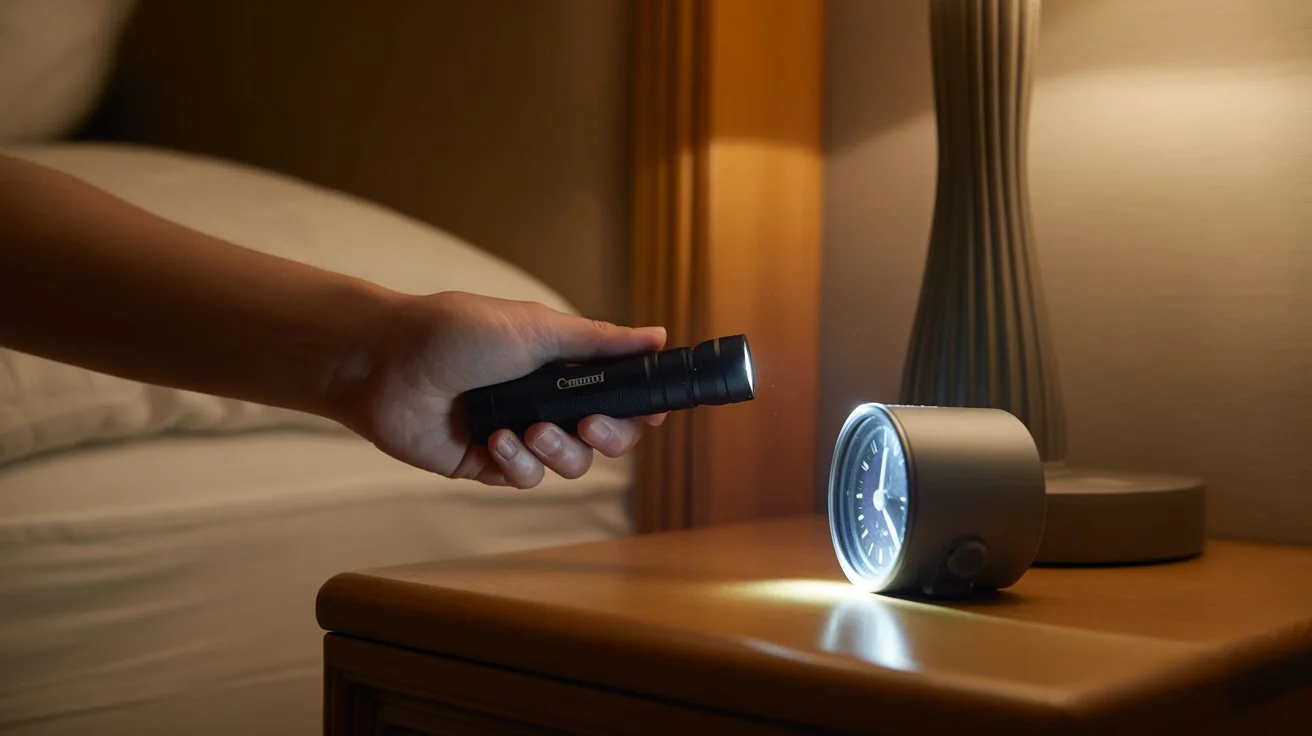
So, can a flashlight find hidden cameras? Yes, it can. A flashlight works by reflecting off the glass lens of a camera. When you shine it in a dark room, camera lenses bounce back a small but visible glint. It is not 100% foolproof, but it is one of the fastest free methods you have right now.
How Hidden Cameras Reflect Light
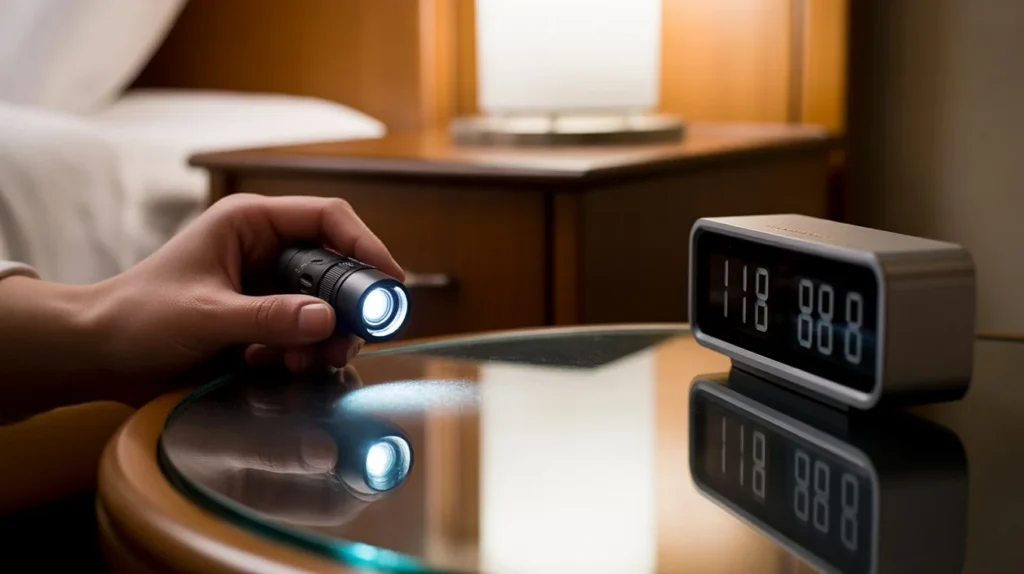
Camera lenses are made of glass or polished plastic. These materials have a property called retroreflection. When light hits them at the right angle, it bounces straight back toward the source.
Think about how cats’ eyes glow in car headlights. The same physics applies to camera lenses.
Hidden cameras, no matter how small, still need a lens. That lens is always slightly reflective. Even a camera the size of a pinhole has a tiny convex glass surface that catches and returns light.
This is exactly why the flashlight method works.
Can a Flashlight Find Hidden Cameras?
Yes, and here is the science behind it. When you shine a bright flashlight around a dark room, the beam hits surfaces and scatters. Most surfaces absorb or randomly scatter light. But a camera lens reflects a sharp, focused point of light back at you.
That small bright dot is the giveaway. Can a flashlight find hidden cameras in all lighting conditions? Dim or dark rooms work best. In bright daylight, the reflected glint is much harder to see. So always do this check with the lights off and curtains closed.
The key is angle. You need to hold the flashlight close to your eyes and slowly scan the room. The reflection only bounces back toward the light source, so your eye needs to be near the beam.
How to Use a Flashlight to Find Hidden Cameras
Follow these steps for the best results:
Step 1: Darken the room Close curtains. Turn off all lights. The darker, the better.
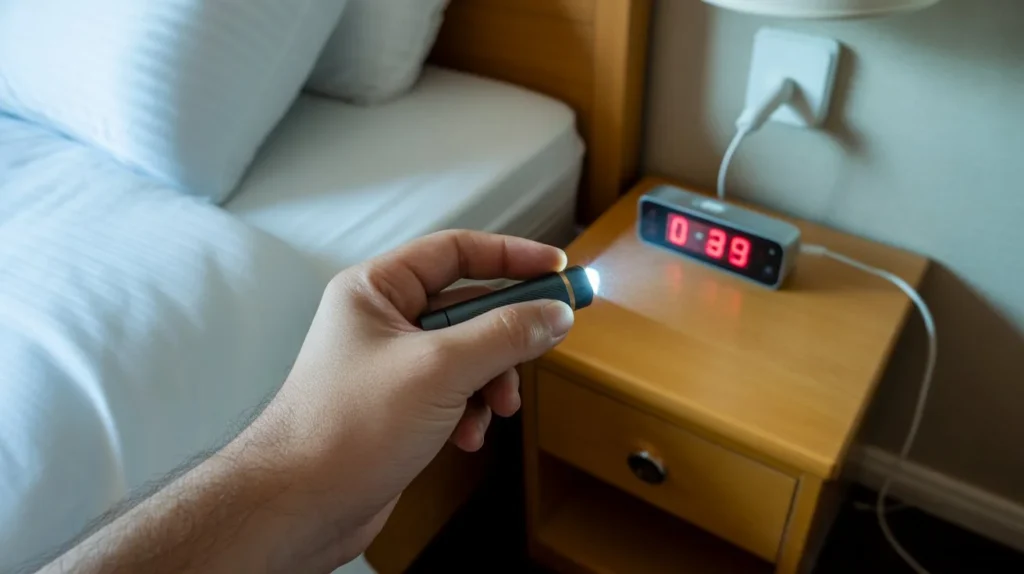
Step 2: Hold the flashlight near your eye Not above your head. Not at arm’s length. Right next to your eye. The reflection travels back along the same path as the beam.
Step 3: Move slowly Scan every wall, shelf, vent, smoke detector, clock, and picture frame. Move in slow horizontal sweeps.
Step 4: Look for a bright glint. You are looking for a tiny, sharp, bright dot. It may be blue, white, or red. It will stand out from the matte surfaces around it.
Step 5: Investigate anything suspicious If you see a glint, walk toward it. Inspect the object closely. Look for a small hole, a lens, or a wire.
A regular phone flashlight works fine for this. An LED torch with a tight beam works even better.
Best Places to Check for Hidden Cameras
Hidden cameras are usually placed where they have a clear line of sight to private areas. Here are the spots to check first:
- Smoke detectors (especially ones that look slightly newer or mismatched)
- Alarm clocks and digital clocks
- Air vents and grilles
- Picture frames and wall art
- Electrical outlets and power strips
- Bookshelves and decorative items
- Mirrors (two-way mirrors are a real concern)
- Televisions (some smart TVs have built-in cameras)
- Wi-Fi routers (uncommon but possible)
- Charging adapters and USB hubs
In hotel rooms and short-term rentals, focus on the bedroom and bathroom areas. These are the most common locations for illegal surveillance devices.
Can a Phone Flashlight Detect Hidden Cameras?
Yes. Your phone flashlight works for the basic lens-reflection method. It is not as powerful as a dedicated LED torch, but it is good enough for close-range scanning.
There is also a second phone method. Some smartphone cameras can pick up infrared (IR) light. Many hidden cameras use IR for night vision. Your eyes cannot see IR, but some phone cameras can.
Here is how to test it:
- Open your phone camera app (front camera works better for this)
- Point a TV remote at the camera and press a button
- If you see a purple or white flash on the screen, your camera detects IR
If your camera can see IR, use it to scan the room slowly. Look for a faint purple or white glow from any suspicious devices.
Note: iPhones with newer sensors block most IR. Android phones and older iPhones tend to work better.
Other Ways to Detect Hidden Cameras
The flashlight method is just one tool. Combine it with these methods from Cam Security Surveillance for a more thorough hidden camera check and stronger privacy protection.
RF Signal Detectors
Radio frequency (RF) detectors pick up wireless transmissions. Wireless hidden cameras send video over RF signals. A basic RF detector costs under $30 and can alert you to active transmitters in a room.
Network Scanning Apps
Apps like Fing or Network Analyzer let you scan the Wi-Fi network. Any connected device shows up with a name or MAC address. Unknown devices labeled “camera” or with unrecognized manufacturer names are red flags.
Hidden Camera Detector Devices
Dedicated lens detectors use a ring of red LED lights. Look through the viewfinder while scanning. Camera lenses reflect back with a distinctive bright circle. These are more reliable than a flashlight alone.
Physical Inspection
Run your hands along walls, vents, and shelves. Feel for small holes, irregular edges, or adhesive marks. Look for tiny screws with disrupted grooves that indicate tampering.
Check for Two-Way Mirrors
Press your fingernail against the mirror surface. On a regular mirror, there is a gap between your fingernail and its reflection. On a two-way mirror, the reflection touches your fingernail directly.
Common Mistakes When Using a Flashlight
People often do this check wrong. Here are the most common errors:
Keeping the lights on. You will miss reflections entirely. The room must be dark.
Holding the flashlight away from your face. The reflection travels back along the same path as the beam. If your eye is not near the light source, you will miss the glint.
Scanning too fast. Slow down. Tiny lenses reflect a very small point of light. Rushing means missing it.
Only checking obvious spots. Cameras are hidden deliberately. Check inside items, not just on top of them.
Assuming a glint means a camera. Glass decorations, mirrors, and shiny objects also reflect. Investigate glints before panicking.
Signs There May Be a Hidden Camera
Beyond the flashlight test, watch for these warning signs:
- Objects placed at unusual angles (facing a bed or bathroom)
- Small holes in walls, ceilings, or furniture
- Devices plugged in but with no obvious purpose
- Smoke detectors in odd locations or with no visible smoke sensor
- Tiny LED lights that blink, especially at night
- Unfamiliar devices on the room’s Wi-Fi network
- Decorative objects that seem too perfectly positioned
Trust your instincts. If something looks out of place, it is worth investigating.
Do All Hidden Cameras Reflect Flashlight Beams?
No, not all of them.
Most consumer-grade hidden cameras have glass lenses that reflect light. But some cameras are designed specifically to reduce reflection. These are called anti-reflective coated or stealth lens cameras.
Pinhole cameras with very small openings also reflect very little light. The smaller the lens opening, the smaller and dimmer the reflection.
Cameras hidden inside objects (like inside a stuffed animal or behind frosted plastic) may reflect poorly or not at all.
This is why a flashlight can find hidden cameras is not a yes/no question with a single answer. It depends on the camera type, distance, and lens quality. For this reason, always combine the flashlight method with other detection techniques.
Professional Hidden Camera Detection
If you suspect surveillance in a rental property or workplace and DIY methods are not giving you confidence, bring in professionals.
Security sweep professionals use:
- Non-linear junction detectors (NLJD): These find electronic components inside walls, even if the camera is off.
- Thermal imaging cameras: Hidden devices generate heat. Thermal cameras detect warm spots behind surfaces.
- Spectrum analyzers: These detect all wireless transmissions in a space, not just standard RF frequencies.
For ongoing protection in your own home or business, a reliable surveillance system of your own is a smart investment. Cam Security Surveillance offers a range of apartment security camera solutions designed to give you complete visibility and peace of mind in your own space. When you control your own cameras, you know exactly what is being recorded and where.
For rentals, you can also request a security inspection from the property management company before your stay.
Privacy and Legal Concerns
Finding a hidden camera is disturbing. Knowing what to do next matters.
In a hotel or rental:
- Do not touch or move the camera
- Document it with photos and video using your phone
- Contact local law enforcement immediately
- Report it to the platform (Airbnb, VRBO, etc.)
Legal note: Recording someone in a private space without consent is illegal in most countries and all U.S. states. Violators can face serious criminal charges.
In a workplace: Employers can legally install cameras in common areas in most jurisdictions. They cannot legally record bathrooms, changing rooms, or other private areas. If you find a camera in a clearly private area, consult an employment attorney.
At home: If someone has placed a camera in your home without your knowledge, this is a criminal act. Contact the police right away and preserve evidence.
Tips to Improve Hidden Camera Detection
Get better at this with a few practical habits:
- Check every new space you stay in. Hotels, vacation rentals, Airbnbs. Make it a routine.
- Bring a small LED flashlight when traveling. Phone flashlights work but a compact torch is more effective.
- Scan the Wi-Fi network first. Network scanning apps take 60 seconds and flag suspicious devices before you even start the physical sweep.
- Check at night. Infrared cameras glow in the dark if you use your phone camera. Night checks catch things daylight misses.
- Look for power sources. Cameras need power. Any device plugged in near a private area deserves a second look.
- Document suspicious objects. Take a photo before you touch anything. This protects you legally.
- Use more than one method. No single detection method catches everything. Combine flashlight, RF detector, network scan, and physical inspection.
Conclusion
A flashlight is one of the most practical tools for spotting hidden cameras. It works because camera lenses reflect light in a unique way that stands out in a dark room. The method is free, fast, and requires no technical skills.
That said, can a flashlight find hidden cameras every single time? No. Anti-reflective lenses, pinhole cameras, and cameras hidden behind objects can reduce or eliminate the reflection. That is why layering your detection methods matters.
Use a flashlight as your first check. Then run a network scan, use an RF detector, and do a physical inspection. The combination gives you the best chance of finding anything that should not be there. If you need expert help, Contact Cam Security Surveillance for trusted hidden camera detection and security support.
Your privacy is worth the five minutes it takes to check.
FAQs
Can a flashlight find hidden cameras in daylight?
It is much harder in daylight. Ambient light drowns out the small reflection from a camera lens. Darken the room for best results.
What color does a camera lens reflect?
Usually a bright white, blue, or slightly reddish dot. The exact color depends on the lens coating and the flashlight color.
Does the flashlight method work on all hidden cameras?
Most standard hidden cameras, yes. Cameras with anti-reflective coatings or very small pinhole lenses may not reflect enough light to be visible.
Can a phone flashlight replace a real torch?
For basic scanning, yes. A dedicated LED torch with a focused beam is more effective at longer distances.
What should I do if I find a hidden camera?
Don’t touch it. Document it with your phone. Call local police and report it to the property owner or platform.
Are hidden camera detectors better than flashlights?
Dedicated lens detectors are more reliable. They use a ring of LEDs and a viewing filter that makes lens reflections much easier to spot. Worth buying if you travel frequently.
Is it legal to search for hidden cameras in a rental?
Absolutely. You have the right to inspect any space you are renting. Looking for surveillance devices in your private rented space is completely legal.