
Weak WiFi often starts when the signal has to pass through thick walls, floors, furniture, or metal objects. A poor signal can cause slow browsing, video buffering, dropped calls, and unstable smart devices. The good news is that you can improve coverage without replacing your entire internet service. Better router placement, the right WiFi band, mesh systems, extenders, and wired access points can make a major difference.
If you are wondering How to Boost WiFi Signal Through Walls?, start by moving your router to a central, open location. Then test the signal in weak rooms. If walls still cause problems, use a mesh system, WiFi extender, or wired access point based on your home’s layout.
Why Do Walls Weaken WiFi Signals?
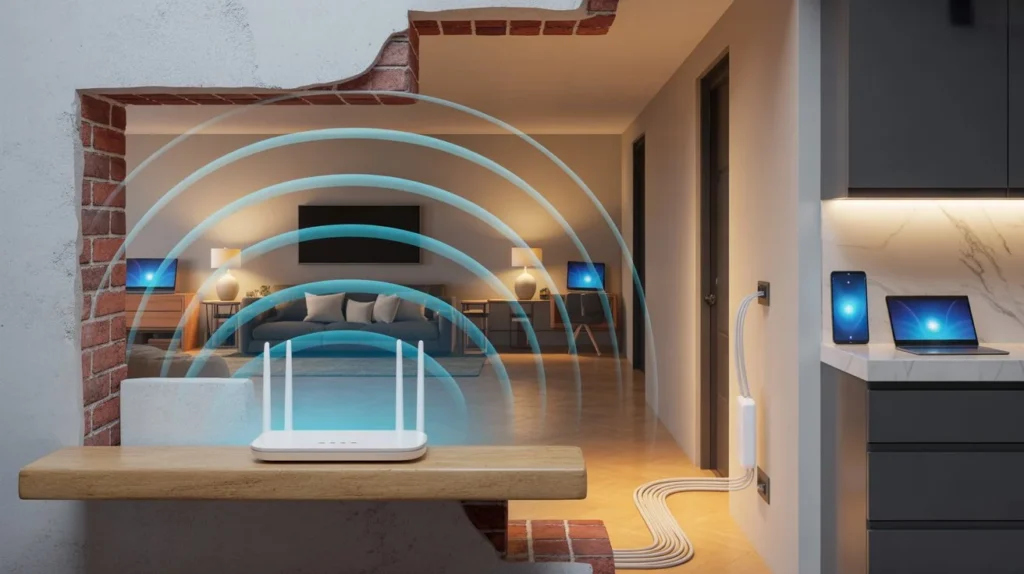
WiFi travels through the air as radio waves. When those waves meet a wall, some of their energy gets absorbed, reflected, or weakened. The amount of signal loss depends on the wall material, thickness, distance, and WiFi frequency. Drywall usually causes less trouble than concrete. Brick, stone, tile, and reinforced concrete can create much larger signal losses. Metal can be even more difficult because it can block or reflect wireless signals.
This is why a phone may show a strong connection in the room next to your router but a weak connection two rooms away. The WiFi band also matters. A 2.4 GHz signal generally travels farther and handles walls better than 5 GHz. However, 5 GHz can offer higher speeds when the device is close enough to the router.
How to Boost WiFi Signal Through Walls
The best solution depends on where the weak signal appears and what you need the connection to do. Try the simple fixes first before buying extra equipment.
1. Move Your Router to a Better Location
Router placement is one of the easiest ways to improve WiFi. Put the router in a central and open area. Keep it above the floor and away from large furniture. Avoid placing it inside a cabinet, behind a television, or next to thick walls.
For example, a router placed in one corner of a two-story home may provide poor coverage on the opposite side. Moving it closer to the center can improve coverage without adding new hardware.
2. Use the 2.4 GHz Band for Longer Reach
Many modern routers offer both 2.4 GHz and 5 GHz networks. If a room is far from the router, 2.4 GHz may provide a more stable connection. It usually travels farther and passes through walls better.
This does not mean 2.4 GHz is always faster. The best choice depends on distance, interference, and the device you are using.
3. Add a WiFi Extender
A WiFi extender can help when one area of your home has a weak signal. The important part is where you place it. Do not put the extender inside the dead zone. It needs to receive a reasonably strong signal from the main router before it can repeat that signal into another area.
For example, if your router works well in the hallway but the bedroom has weak coverage, placing the extender between those areas may work better than putting it inside the bedroom.
4. Install a Mesh WiFi System
Mesh WiFi can be a better choice for larger homes or homes with several weak areas. Instead of relying on one router, a mesh system uses multiple nodes. These nodes work together to provide coverage across different parts of the property.
Mesh WiFi can be useful for:
- Large houses
- Multi-story homes
- Long floor plans
- Homes with several dead zones
- Properties with smart home devices
A mesh system also gives you more control over where coverage is needed.
5. Use a Wired Access Point
For difficult walls, a wired access point can be one of the most reliable solutions. An Ethernet cable connects the access point to the main network. The access point then creates WiFi in the area where coverage is needed. This avoids asking one wireless signal to travel through several walls. It can be especially useful in offices, large homes, garages, and buildings with concrete walls.
If you already have Ethernet cabling, this can be a better option than repeatedly adding wireless repeaters.
6. Reduce Wireless Interference
Other devices can affect WiFi performance. Keep your router away from equipment that can create wireless interference. Nearby networks can also compete for the same channels, especially in apartments and crowded neighborhoods.
If your WiFi is strong near the router but unstable at certain times, interference may be part of the problem.
How to Improve WiFi Through Concrete or Brick Walls
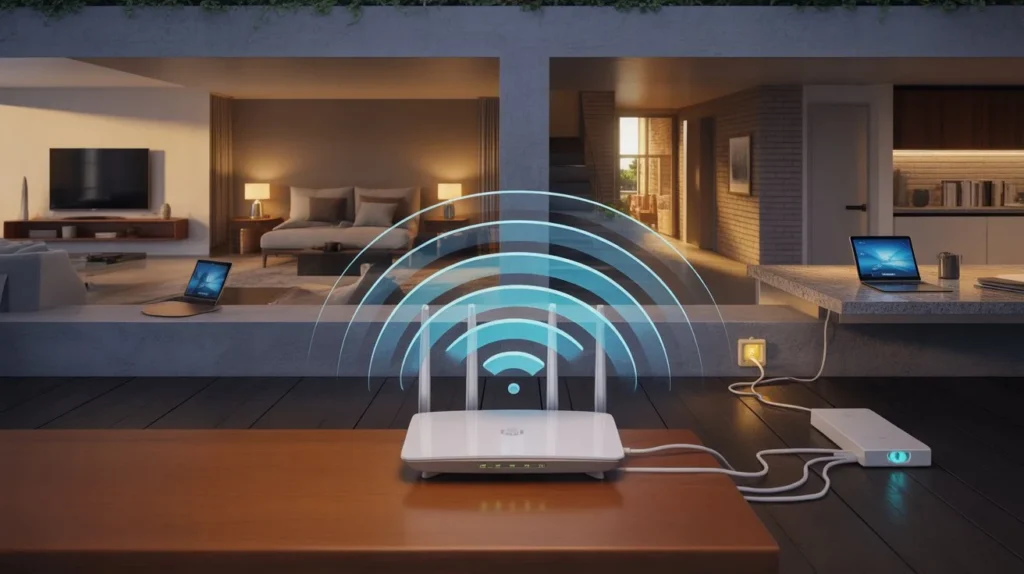
Concrete and brick walls can make WiFi coverage much harder. Reinforced concrete can be especially difficult because metal inside the structure may further affect the signal. If you need WiFi through these walls, start with router placement. Place the main router where it has the clearest path to the areas that need coverage.
For a large property, use mesh nodes or wired access points rather than expecting one router to cover everything. A wired access point is often the stronger choice when reliability matters. This is useful for work areas, security cameras, offices, and other devices that need a stable connection.
Does WiFi Go Through Walls?
Yes, WiFi can pass through walls, but the signal becomes weaker as it travels through materials. The number of walls is not the only factor. A thin drywall partition may have a small effect, while thick concrete or brick can cause much greater loss.
So, does WiFi go through walls? Yes, but the quality of the connection after the wall depends on the material, thickness, distance, frequency, and interference around the network.
Does 5GHz WiFi Go Through Walls?
Yes, 5 GHz WiFi can pass through walls, but it usually loses strength faster than 2.4 GHz as distance and obstacles increase. This makes 5 GHz useful for nearby devices that need good speed. For distant rooms separated by several walls, 2.4 GHz may provide better coverage.
If you have both bands available, test them in the room where you have problems. The strongest option is the one that gives your device a stable connection for its actual use.
Can WiFi Pass Through Walls?
Yes, can WiFi pass through walls is a common question because wireless signals do not simply stop at a wall. They continue through it with some signal loss. The type of wall matters more than simply counting walls. For example, three lightweight interior walls may cause less trouble than one thick reinforced concrete wall.
That is why WiFi coverage should be tested at the actual location of the device instead of relying only on the router’s advertised range.
Best WiFi Solution for Different Situations
Different properties need different solutions.
| Situation | Good option |
| Small home with one weak area | Better router placement |
| One distant bedroom | WiFi extender |
| Large home | Mesh WiFi |
| Multiple floors | Mesh or wired access points |
| Thick concrete walls | Wired access points |
| Office building | Multiple access points |
| Fixed smart devices | Ethernet where possible |
The goal is not to buy the most expensive equipment. The goal is to provide stable coverage where people and devices actually need it.
Common Mistakes That Reduce WiFi Signal
Several simple mistakes can make a WiFi network perform worse.
Putting the router in a cabinet: Enclosing the router can block or weaken the signal.
Placing it on the floor: A low position may reduce useful coverage.
Putting an extender too far away: An extender cannot provide a strong connection if its own connection to the router is poor.
Using only 5 GHz: 5 GHz can be fast, but it may not be ideal for distant rooms.
Ignoring interference: Nearby networks and electronic devices can affect performance.
Buying equipment based only on advertised range: Real homes contain walls, furniture, floors, and interference. Actual coverage can be very different from the number shown on the box.
How to Check WiFi Signal Strength Through Walls
Testing your network before buying equipment can save time and money. Start near the router and check the connection. Then walk into each room where you need WiFi. Pay attention to signal strength, download speed, upload speed, and connection stability. Do not test only once. Walk around the room and test near the actual location of your phone, computer, TV, or camera.
For example, a camera installed near an outside wall may have a different connection from a phone used in the center of the same room. You should also test after making one change at a time. Move the router first, test again, then consider an extender or mesh system if needed.
Can WiFi Reach Through Multiple Walls?
WiFi can reach through multiple walls, but each wall can reduce the available signal. There is no single distance that works for every home. A router may provide good coverage through several light interior walls but struggle with one thick concrete wall.
The building layout also matters. Floors can create problems similar to walls, especially in multi-story properties. If a device is far from the router and several obstacles are between them, adding another access point is often more reliable than trying to push one signal farther.
When Should You Use a Professional WiFi Installation?
Professional help makes sense when basic router placement does not solve the problem. You may need professional planning if you have a large home, multiple floors, thick walls, a commercial property, or many connected devices. A professional can review the layout, identify weak coverage areas, plan access point locations, and determine where wired connections make sense.
A properly planned wifi installation service can also help when security cameras, computers, smart devices, and other equipment all need stable network access.
Cam Security Surveillance can help plan WiFi coverage around the actual needs of a home or business. The goal is to place network equipment where it provides useful coverage instead of simply adding devices without a plan.
For properties with difficult walls, wired connections can also provide a more stable foundation for important devices.
Conclusion
Improving WiFi through walls starts with simple changes. Move the router to a central location, keep it away from obstructions, and test both 2.4 GHz and 5 GHz where available. If the problem remains, consider a WiFi extender, mesh system, or wired access point. For thick concrete walls and large properties, wired access points often provide a more dependable solution.
The best answer to How to Boost WiFi Signal Through Walls? is not always a stronger router. It is the right network design for your building, distance, wall materials, and connected devices. Contact us today to discuss your WiFi coverage needs and find the right solution for your property.
FAQs
What is the easiest way to boost WiFi through walls?
Move your router to a central, elevated, open location. If that does not solve the problem, try a WiFi extender or mesh system.
Does 2.4 GHz WiFi go through walls better than 5 GHz?
Yes. 2.4 GHz generally travels farther and handles obstacles better, while 5 GHz can provide higher speeds at shorter distances.
Can a WiFi extender work through concrete walls?
It can, but the extender still needs a usable signal from the main router. A wired access point may work better for thick concrete walls.
How far can WiFi reach through walls?
There is no fixed distance. Range depends on the router, frequency, wall materials, interference, antenna design, and building layout.
Is mesh WiFi better than a WiFi extender?
Mesh WiFi can be better for larger homes and several weak areas. An extender may be enough for one small coverage gap.
Should I use an Ethernet cable for better WiFi?
An Ethernet connection to an access point can provide a more stable network connection in difficult areas. It is especially useful for large properties and thick walls.