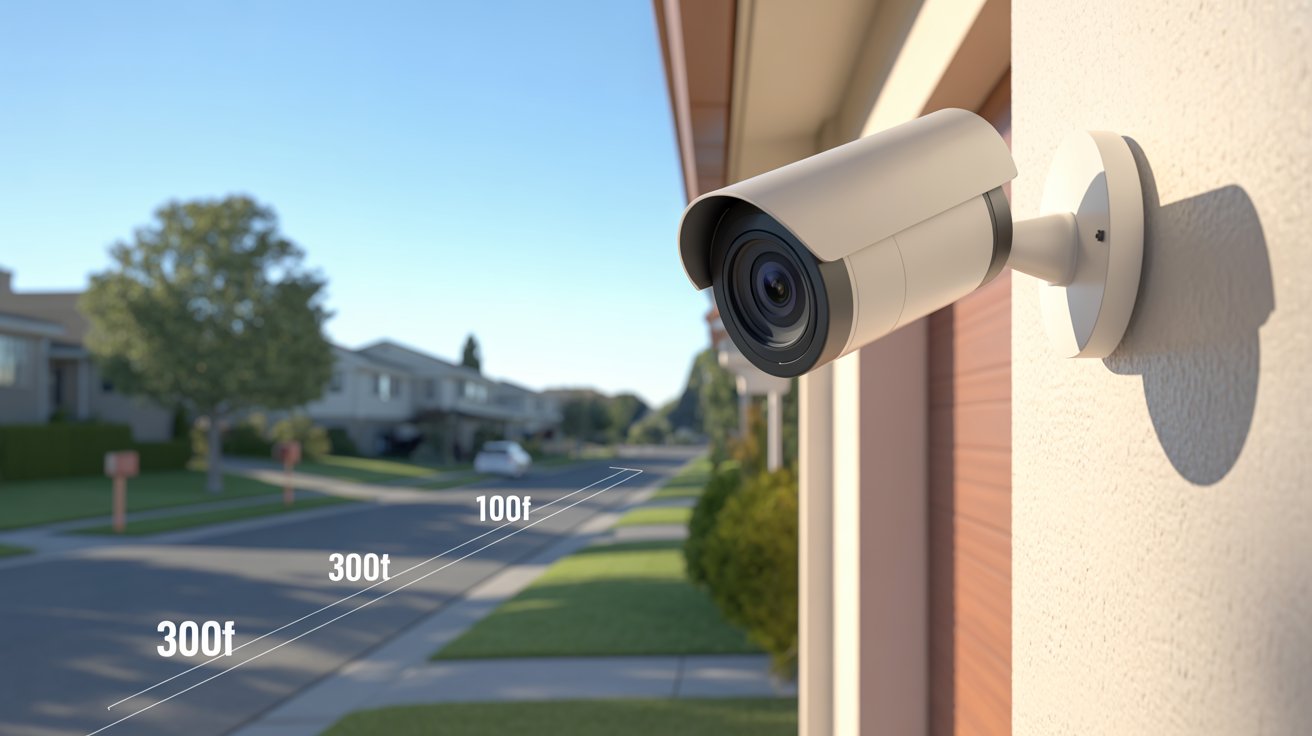
A security camera can usually see from about 20 to 100 feet, depending on its lens, resolution, lighting, and placement. Long-range cameras can cover 200 feet or more when paired with the right lens and zoom.
However, seeing an object is not the same as clearly identifying a person or license plate.
Your camera needs the right lens and lighting for the distance you need to monitor. So, How Far Can Security Cameras See? The useful range depends on what you need to see, not just the camera’s advertised range.
How Far Can a Security Camera See?
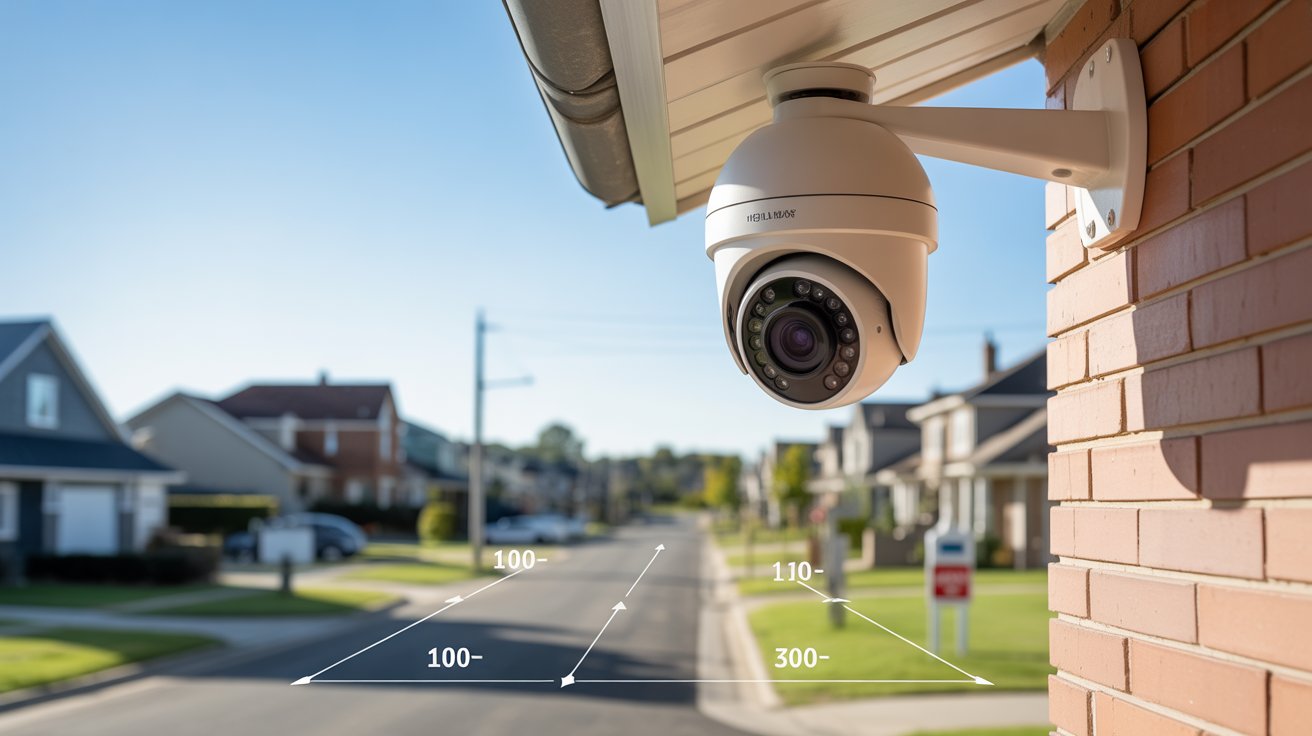
There is no single viewing distance that applies to every security camera. A basic indoor camera may provide useful detail across 20 to 40 feet. A good outdoor camera can cover 50 to 100 feet. Long-range cameras with telephoto or varifocal lenses can reach 100 to 300 feet or more.
The key difference is image detail. A camera may detect movement at 150 feet but fail to show enough facial detail for identification. This is why the CCTV camera view range should not be judged by distance alone.
For example, imagine a camera facing a driveway. At 80 feet, you may see that a person entered the property. At 30 feet, the same camera may show enough detail to recognize that person.
This creates four useful levels of camera performance:
- Detection: You can tell that something is present.
- Observation: You can see what the object or person is doing.
- Recognition: You can recognize a familiar person.
- Identification: You can capture enough detail to identify someone with confidence.
For home security, identification is often more useful than maximum viewing distance.
What Determines How Far a Security Camera Can See?
Several factors control the practical range of a camera.
Camera Resolution
Resolution affects how much detail the image contains. A 1080p camera can provide good results for many homes, while 4K cameras offer more pixels for distant subjects. Higher resolution helps when you need to crop an image. It does not automatically make a camera a long-range camera.
A 4K camera with a wide lens may show a large area but make distant faces appear small. A lower-resolution camera with a suitable telephoto lens may provide better detail at a particular distance.
Lens and Focal Length
The lens is one of the most important parts of long-distance surveillance. Wide-angle lenses cover more space. They work well for rooms, entrances, porches, and small yards. The tradeoff is that distant objects take up fewer pixels. A narrow lens covers less area but gives you more detail on distant subjects. Varifocal lenses are useful because their focal length can be adjusted during installation.
Optical Zoom
Optical zoom changes the lens view without simply enlarging the existing pixels. This makes it much better for distant monitoring than digital zoom. Digital zoom crops and enlarges part of the image. When pushed too far, the result can look blurry. If you need to watch a gate, parking area, or distant driveway, optical zoom is usually the better choice.
Camera Height and Angle
Mounting position also changes the useful range. A camera mounted too high may capture the top of someone’s head instead of useful facial detail. A camera mounted too low may be easier to damage or tamper with. The best height depends on the property, camera type, and area being monitored. The goal is to create a clear view without unnecessary blind spots.
Lighting Conditions
Light can make a major difference. A camera may produce a sharp image during the day but lose detail at night. Bright lights can also cause glare. Headlights, reflective surfaces, and direct sunlight may wash out important parts of the image. This is why camera range should always be judged in the actual lighting conditions where the camera will operate.
How Far Can Security Cameras See at Night?
Night vision usually covers a shorter practical distance than daytime viewing. Many outdoor cameras use infrared LEDs to illuminate nearby areas in darkness. A camera may advertise an infrared range of 80, 100, or even 150 feet. That does not mean it will provide perfect facial detail at that distance.
IR range tells you how far the camera can send infrared light. It does not guarantee identification quality.
For better nighttime results, consider:
- Strong but controlled infrared lighting
- Good low-light sensors
- Proper camera placement
- Reduced glare
- Adequate outdoor lighting
- A suitable lens for the target distance
If your main concern is a dark driveway or large parking lot, test the camera at night before finalizing its position.
How Far Can a 1080p Security Camera See?
A 1080p security camera can provide useful coverage for many homes and small businesses. In practical conditions, 20 to 60 feet is a common range for useful detail, although the actual distance varies greatly. A 1080p camera with a wide lens may cover a large yard but provide limited detail at the far end. A narrow lens can concentrate those pixels on a smaller area.
For a front door, porch, hallway, or small driveway, 1080p may be enough. For a large parking lot or distant entrance, a higher-resolution camera with the right lens may be a better choice.
How Far Can a 4K Security Camera See?
A 4K security camera has four times the pixel count of a 1080p image. That extra detail can help when monitoring larger areas or cropping recorded footage. Still, 4K does not mean the camera can clearly identify someone hundreds of feet away. Lens selection remains critical. A 4K wide-angle camera may cover a large yard, while a 4K varifocal camera can focus more detail on a distant gate.
For example, a business may use a 4K camera to cover a parking area while using another camera with a narrower lens at the entrance. This gives each camera a clear job instead of expecting one camera to cover everything.
How Far Can a PTZ Security Camera See?
PTZ cameras can pan, tilt, and zoom. Their optical zoom makes them useful for large properties that need long-distance monitoring. A PTZ camera may monitor a parking lot, warehouse yard, school property, or commercial site from a central position. An operator can move the camera toward an area of interest and zoom in.
The main limitation is coverage. A PTZ camera cannot physically watch every direction at the same time. If it is pointed toward one area, another area may be outside its current view.
For this reason, large properties often use fixed cameras for constant coverage and PTZ cameras for flexible monitoring.
Can Security Cameras See Through Walls?
Standard security cameras cannot see through solid walls. Their normal lenses require a clear line of sight to capture an image. Walls, fences, trees, vehicles, and other objects can block the camera’s view. A camera also cannot identify something simply because its advertised range is very high.
Thermal imaging is different because it detects heat rather than normal visible light. However, thermal cameras should not be treated as ordinary CCTV cameras that can see through walls. For normal home and business surveillance, plan camera positions around clear lines of sight.
How Far Can a Security Camera See a License Plate?
License plate capture requires more than a high-resolution camera. The camera needs the right viewing angle, lens, shutter settings, lighting, and distance. Vehicle speed also matters. A wide-angle camera mounted far from a driveway may show the vehicle but make the plate too small to read. A camera designed for license plate capture can use a narrower field of view and settings that better handle moving vehicles.
If plate capture is important, avoid choosing a camera based only on its megapixel count. The camera should be selected for the distance and speed of the vehicles it must record.
How to Choose a Security Camera for Long-Distance Viewing
Start by deciding what you need to see.
If you only need to detect movement across a large yard, a wide outdoor camera may work well. If you need to identify people near a distant gate, you may need a narrower lens.
Use this checklist:
- Measure the distance from the camera to the target.
- Decide whether you need detection, recognition, or identification.
- Check the lens focal length.
- Consider optical or varifocal zoom.
- Compare daytime and nighttime performance.
- Check the expected infrared range.
- Look for obstructions in the camera’s path.
- Test the planned camera position before permanent mounting.
This approach gives you a more realistic cctv camera vision range than relying on a number printed on a product box.
Best Security Camera Types for Different Distances
| Distance | Suitable Camera Type | Common Use |
| 10 to 30 feet | Indoor or Wi-Fi camera | Rooms and entrances |
| 30 to 60 feet | Standard outdoor camera | Yards and driveways |
| 60 to 100 feet | 2K or 4K outdoor camera | Large yards and parking areas |
| 100 to 200+ feet | Varifocal or telephoto camera | Gates and large properties |
| Large areas | PTZ camera | Parking lots and commercial sites |
| License plates | LPR camera | Vehicle entrances |
These ranges are practical examples, not fixed limits. Your actual surveillance camera coverage depends on the camera, lens, lighting, and target.
How to Improve the Viewing Distance of a Security Camera
You can often improve useful range without simply buying the most expensive camera. Choose a lens that matches the target distance. Improve lighting where possible. Keep the lens clean and remove objects that block the view. Use optical zoom instead of relying heavily on digital zoom. Check nighttime footage before deciding that the camera is working well.
Network quality also matters for IP cameras. A weak connection may cause dropped frames or poor live viewing, even when the camera itself produces a good image. For larger properties, several properly placed cameras are often better than one camera aimed at everything. Good coverage comes from planning, not simply increasing camera resolution.
Professional Security Camera Installation in Indianapolis
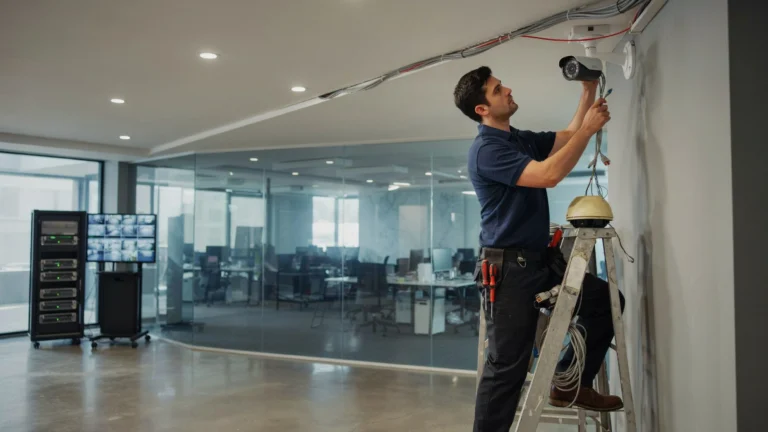
Long-distance surveillance works best when the camera, lens, mounting point, and target are planned together. Professional security camera installation Indianapolis services can help identify blind spots, select suitable lenses, set mounting angles, and position cameras for useful day and night coverage.
Cam Security Surveillance helps homeowners and businesses plan security camera systems around the areas that matter most. A professional installation can also help with PoE wiring, NVR placement, remote viewing, and camera positioning. For Indianapolis properties, the right setup may include fixed cameras around entrances, a narrower camera for a driveway, and PTZ coverage for larger areas.
The goal is simple: every camera should have a clear purpose.
Conclusion
So, How Far Can Security Cameras See? Most standard cameras provide useful coverage within 20 to 100 feet, while long-range systems can cover much greater distances. The advertised range is only part of the answer. Resolution, lens type, zoom, lighting, mounting height, weather, and viewing angle all affect the final image.
If you need to identify people or read license plates, focus on detail rather than maximum distance. A properly selected lens and camera position can matter more than simply choosing a higher megapixel count. Good security coverage comes from matching the camera to the property and the task. Contact us today to discuss the right security camera solution for your property.
FAQs
How far can a home security camera see?
Many home security cameras provide useful detail across 20 to 60 feet. Outdoor models with suitable lenses can cover 100 feet or more.
Can a security camera see 100 feet away?
Yes. Many outdoor cameras can monitor objects at 100 feet. Clear identification at that distance depends on resolution, lens, lighting, and camera angle.
How far can a security camera see at night?
Nighttime range varies by infrared power, lighting, sensor quality, and lens. A camera may detect activity at 100 feet but provide useful facial detail over a shorter distance.
Does 4K make a security camera see farther?
4K provides more image detail, but it does not automatically increase physical viewing distance. Lens selection and field of view remain very important.
Can security cameras see through walls?
No. Standard security cameras need a clear line of sight. Solid walls block their normal image.
What camera is best for long-distance viewing?
Varifocal, telephoto, and PTZ cameras are often better choices for long-distance monitoring. The right option depends on the target distance and required detail.
What is the difference between CCTV camera range and viewing distance?
CCTV camera range can refer to several things, including viewing distance, infrared range, or transmission distance. Always check what the manufacturer means by “range.”
How can I get better surveillance camera coverage?
Plan each camera around a specific area. Use suitable lenses, proper mounting positions, good lighting, and enough cameras to avoid major blind spots.