Security cameras are a necessity in today’s homes and businesses. One of the best features you can have these days is night vision. If you have any concerns about property protection, monitoring your family, or you just want to keep an eye on your place of work, understanding How Do Night Vision Cameras Work will help you in making the right decision when selecting a security system.
Normal cameras do not perform well in the dark, but Cam Security Surveillance offers night vision CCTV cameras designed to capture clear, detailed footage in low-light and complete darkness. Using advanced infrared technology and high-quality image sensors, these modern security cameras provide reliable 24/7 surveillance, helping you protect your home or business around the clock.
What Are Night Vision Cameras?
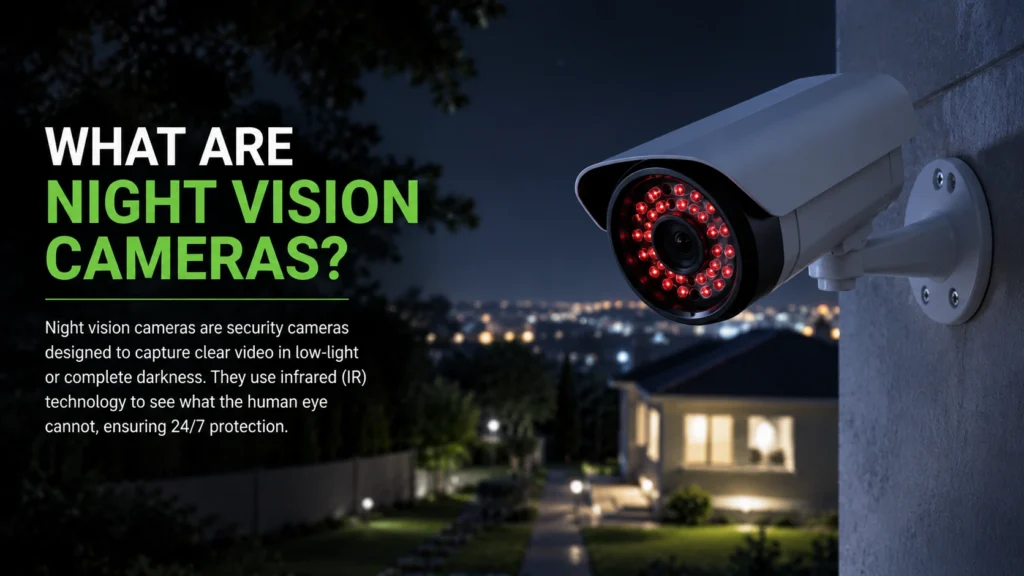
Night vision cameras are surveillance equipment which captures video in dark or low light conditions. Normal cameras use visible light to create an image, but night vision cameras are equipped with special technologies that enable them to “see” in the dark in a way similar to human vision.
The majority of night vision CCTV cameras also use infrared (IR) light to illuminate areas like driveways, parking lots, warehouses, offices, houses, and so on even during the night.
How Do Night Vision Cameras Work?
The solution to How Do Night Vision Cameras Work? can be found in infrared light and image sensors that are very sensitive.
Amongst these cameras are included:
Infrared LEDs
High-sensitivity image sensors
Image processors
Special infrared filters
In the daytime, the camera is just a regular security camera. With the decline in lighting, the camera will automatically go into night mode.
The camera lens is surrounded by the infrared LEDs, which also emit invisible infrared light. It ricochets off nearby surfaces, and then the light returns so it can produce a high-contrast photo in black and white.
As infrared light cannot be seen by human eyes, your eyes see a pitch-dark environment while the camera records high-resolution video. If you are looking for reliable security camera installation Indianapolis, infrared security cameras provide clear night-time footage and dependable protection for homes and businesses.
What Are Infrared Security Cameras?
Infrared security cameras are cameras which has a application of infrared technology to capture detailed images even in total darkness or little light.
The benefits are:
Around-the-clock monitoring
Invisible Infrared Illumination
Dependable nighttime video capture
Automatic switching day/night
The power consumption is lower.
Infrared technology has become the standard for home and business security systems.
What Are IR Night Vision Cameras?
IR night vision cameras have infrared LEDs placed in a circle around the camera lens.
When the sun goes down:
The infrared LEDs turn on automatically.
The camera removes its infrared filter.
Remove filter
The sensor detects reflected infrared light.
The images are sharp even in pitch black.
Most good quality IR night vision cameras automatically transition between color daytime viewing/recording and black and white nighttime viewing/recording.
Why Are Night Images Usually Black and White?
Why do we see buzzing black and white images on night vision cameras?
The answer is simple.
Color imaging needs far more light than its monochrome cousin. When in black & white mode, the camera sensor is a lot more sensitive to Infrared light.
This provides:
Higher image quality,
longer detection distance,
reduced image noise,
enhanced visual effect
ADVERTISEMENT
A few high-end models do come with Color Night Vision, which keeps the color even when in the dark.
Types of Night Vision Technology
There are a variety of night vision systems on the market these days.
1: Infrared Night Vision
This is the most popular technology.
Benefits include:
Economical
Dependable/reliable
Enjoy complete darkness when working outdoors!
Best Buy’s home security experts say it’s perfect for home security
A majority of IR night vision cameras operate this way.
2: Low-Light Color Night Vision
Instead of being based on infrared completely, low-light security cameras come with high-end sensors that are able to capture color images in low illumination.
They work well around:
Streetlights
Porch lights
Parking lot lighting
Garden lights
These cameras allow you to identify your subject/target more thoroughly than with conventional infrared cameras.
3: Thermal Imaging
Thermal cameras see heat, not reflected light as the traditional night vision cameras do.
Benefits are:
See people through fog
Operate in smoke
Detect animals
Detect at long-range
Nevertheless, thermal imaging devices cost an order of magnitude more than typical nightvision CCTV cameras.
What Are Low Light Security Cameras?
Low light security cameras are engineered to enhance image quality with very sensitive image sensors.
Rather than just rely on infrared LEDs, these cameras take advantage of more ambient light.
Advantages include:
Full color at night recording
More accurate facial recognition
Enhanced LP visibility
More natural-looking video
Over the years, low-light security cameras are now more commonplace, with many companies who use them in their parking lots and commercial doors.
Advantages of Night Vision CCTV Cameras
There are numerous advantages to having night vision CCTV cameras installed.
1: 24-Hour Guard
Although you can’t see it, your property is still being monitored 24/7 even after nightfall.
2: Crime Prevention
Cameras in plain sight will deter:
Theft,
vandalism,
trespassing.
3: More/Better Evidence
Above are positive effects of visible security cameras.
Good quality nighttime video footage can be used to identify:
Intruders,
Vehicles,
suspicious activity.
4: Efficient & Automatic Operation
Day-to-night operation. Most cameras have day mode/night mode configurable or automatic mode without user intervention.
5: Remote Viewing
The new systems let you check in live from smartphones, tablets and more, whenever you want. There are numerous advantages to having night vision CCTV cameras installed.
Conclusion
If you have been curious about How Do Night Vision Cameras Work? The How Do Night Vision Cameras Work The Answer Infrared illumination sensitive image sensors and intelligent image processing. If you want to know how night vision cameras work, then it is a combination of infrared light and sensitive image sensors along with some intelligent software. These new technologies make it possible for cameras to record clear videos when eyes can’t see.
Whether you’re looking for infrared security cameras, IR night vision cameras, CCTV night vision cameras, or advanced low-light security cameras, investing in proven night vision technology helps protect your home or business day and night. Understanding how these cameras work and choosing the right features for your property ensures clear footage, reliable performance, and greater peace of mind. With the right system in place, you can count on dependable surveillance around the clock. Contact us today to find the best night vision security camera solution for your property and receive expert installation tailored to your security needs.
FAQs
Do night vision cameras work in complete darkness?
Yes. Most night vision cameras use infrared (IR) LEDs to emit invisible infrared light that reflects off nearby surfaces. The camera’s sensor picks up this reflected light and produces a clear black-and-white image, even in pitch-black conditions.
Why do night vision cameras show black-and-white footage instead of color?
Color imaging requires much more light than black-and-white imaging. In low-light or dark conditions, switching to monochrome makes the camera sensor more sensitive to infrared light, resulting in sharper images, longer detection range, less noise, and better overall visibility. Some high-end models offer color night vision, but this is less common.
What’s the difference between infrared, low-light, and thermal night vision cameras?
- Infrared cameras use IR LEDs to illuminate the scene and are the most common, affordable option.
- Low-light color cameras rely on highly sensitive sensors to capture color footage using ambient light sources like streetlights or porch lights.
- Thermal cameras detect heat rather than reflected light, allowing them to see through fog and smoke and detect people or animals at long range though they’re significantly more expensive.
Do night vision cameras switch between day and night mode automatically?
Yes. Most cameras are designed to detect changes in ambient light and automatically switch between color daytime recording and black-and-white night mode, removing the need for manual adjustment.
Can I view night vision camera footage remotely?
Yes. Most modern systems support remote viewing through smartphones, tablets, and other devices, allowing you to check live footage from anywhere at any time.